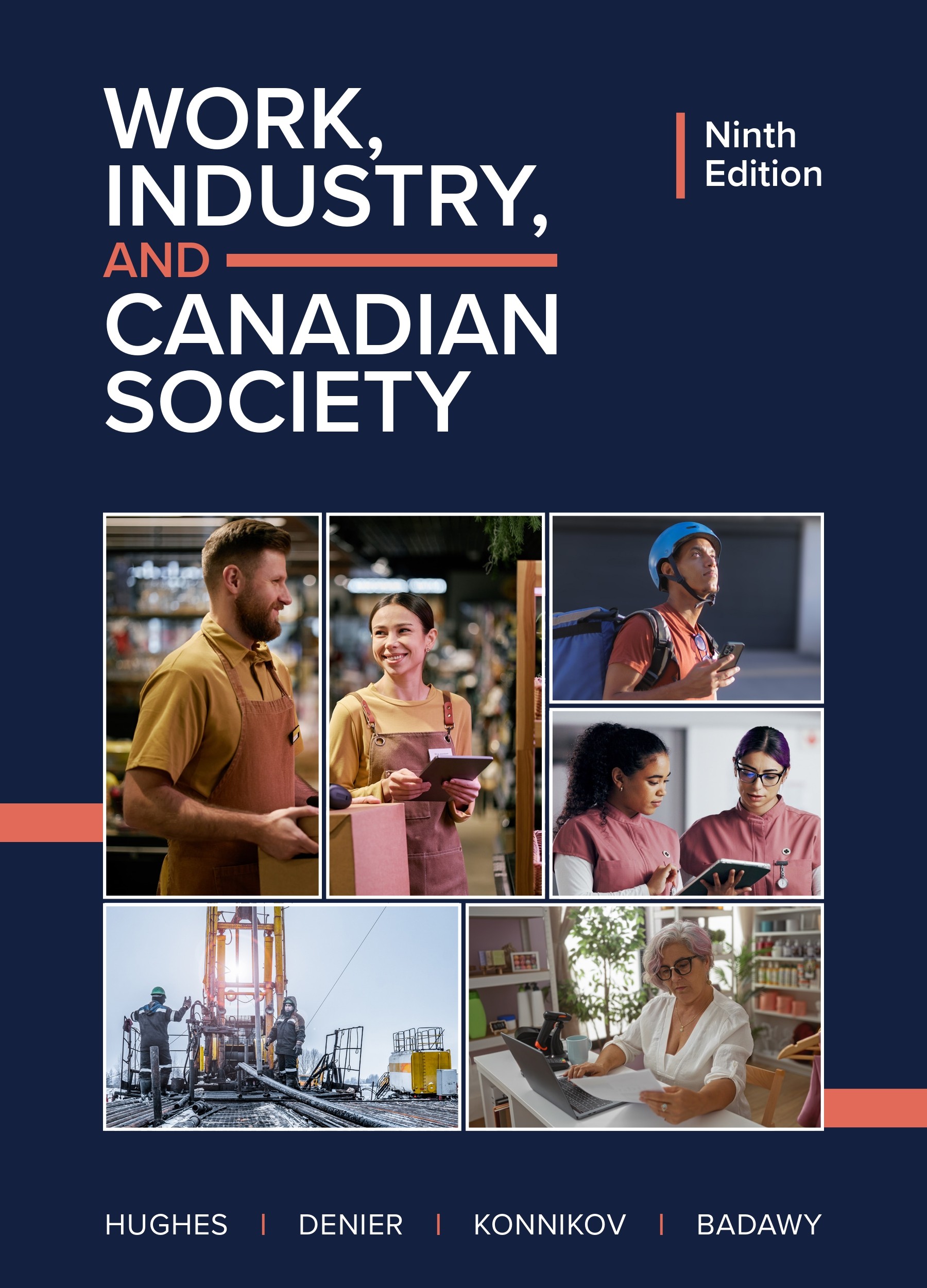
By: Karen Hughes, Nicole Denier, Alla Konnikov, Phil Badawy

Work, Industry, and Canadian Society, 9th Edition

ISBN: 9781998534562 | © 2027

Print Price: $98.95
Digital Price: $89.06

Overview

COMING SOON!

With a long-standing history, Work, Industry, and Canadian Society has become a foundational text in the field of Sociology of Work in Canada. Originally developed by Harvey J. Krahn and Graham S. Lowe, with Karen D. Hughes joining the author team in the 5th edition, the text has evolved through successive editions.

The 9th edition builds on this established legacy with a refreshed author team. Karen D. Hughes continues her contribution to the text, joined by Nicole Denier, Alla Konnikov, and Phil Badawy, who bring new expertise, research, and perspectives to its continued development.

This revised edition provides a thoroughly updated and comprehensive examination of the changing nature of work, employment, organizations, and management in Canada. Drawing on current scholarship, empirical findings, and emerging theoretical and policy debates, it offers students a deeper understanding of contemporary workplace issues within both Canadian and international contexts. The text traces work from the Industrial Revolution to today’s global economy, examining current Canadian employment trends, job quality, unemployment, and labour market inequality examining pressing issues, including artificial intelligence, global trade disruptions, and precarious work. Each chapter features opening vignettes, discussion questions, and curated lists of films and music about work, making it an engaging resource for students and instructors alike.

With updated research, current statistics, real-world examples, and engaging multimedia resources, the 9th edition continues to offer an essential resource for students exploring the sociology of work and the evolving relationship between work and society.

What’s New in the 9th Edition?

  • The Future of Work: Expanded coverage of Artificial Intelligence (AI), its Impact on Employment, and Emerging Workplace trends.
  • Changing Economy and Employment: New discussion of Global Trade Disruptions, Tariffs, the App-Based Gig Economy, Precarious work, and Changing Employment Patterns.
  • Canada’s Evolving Workforce: Updated examination of Canada’s increasingly Diverse and Aging workforce, including the work experiences of Indigenous peoples.
  • Gender, Work, and Inequality: Expanded coverage of the Gender Wage Gap, Work-Family Dynamics, Labour Market Polarization, and growing Social Inequality.
  • Updated Research and Statistics: All tables and figures have been revised with the latest available data, alongside more than 400 new references and updated chapter-opening vignettes.
  • Enhanced Learning Resources: Updated Discussion Questions and curated lists of Songs, Films, and other Audio Resources at the end of each chapter making it an engaging resource for students and instructors alike.

Table of Contents

Chapter 1: Historical Perspectives on Work

Chapter 2: Contemporary Debates and Issues

Chapter 3: Canadian Employment Trends

Chapter 4: Good Jobs, Bad Jobs, No Jobs

Chapter 5: Labour Markets: Opportunities and Inequality

Chapter 6: Gender and Paid Employment

Chapter 7: Household, Family, and Caring Work

Chapter 8: Organizing and Managing Work

Chapter 9: In Search of New Managerial Paradigms

Chapter 10: Conflict and Control in the Workplace

Chapter 11: Unions and Industrial Relations

Chapter 12: Alternative Approaches to Organizing Work

Chapter 13: Work Values and Work Orientations

Chapter 14: Job Satisfaction, Alienation, and Work-Related Stress

About the Authors

Karen Hughes is a professor at the University of Alberta. Her research and teaching focus on the sociology of work, organizations, and labour markets. She holds a Ph.D. from the University of Cambridge and has published widely on work-related issues, focusing on women’s employment and entrepreneurship; AI and labour market inequality; work-family dynamics; and gender inclusive economies. Dr. Hughes is a member of several editorial review boards, and a past recipient of the SSHRC Thérèse Casgrain Fellowship for leading research on women and social change. She is also a Visiting Research Fellow at Babson College.

Nicole Denier is a professor of sociology at Colby College. Her research examines the intersection of social and economic inequality in North American labour markets, focusing on areas such as labour market instability, sexual orientation disparities, immigrant integration, and the impact of artificial intelligence on work. Dr. Denier co-directs the Work and Family Researchers Network Early Career Fellows program and serves on the editorial boards of the Canadian Review of Sociology and Canadian Studies in Population. She earned her bachelor’s degree in economics and sociology, as well as her PhD in sociology, from McGill University.

Alla Konnikov is a professor of sociology at Concordia University of Edmonton. She specializes in the sociology of work, international migration, and gender, employing an intersectional approach to explore how inequalities manifest in organizational settings, labor markets, and professions. Her research encompasses women’s employment trajectories, immigrants’ skills transferability in professional fields, and the role of artificial intelligence in influencing workplace inequalities. Dr. Konnikov earned her PhD in Sociology from the University of Calgary and teaches courses on the sociology of work, international migration, inter-group relations, and social statistics.

Phil Badawy is a professor of sociology at the University of Alberta. His interests focus on work-family dynamics, status inequality, and health. His research investigates how working conditions influence well-being, with a focus on changes over time. One ongoing project examines the COVID-19 pandemic’s impact on Canadian workers’ stress and health. Dr. Badawy teaches courses on social methodology and the sociology of work and industry. He is also a co-author of studies on work-life conflict during the COVID-19 pandemic and the status dynamics of role blurring. He earned his PhD from the University of Toronto.